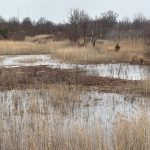
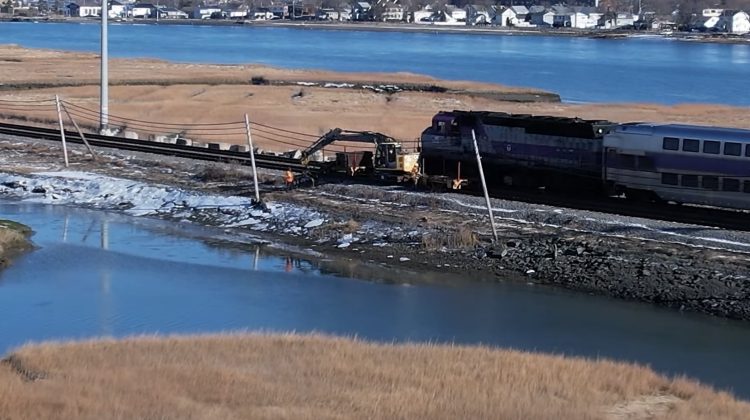
SAUGUS — Three large discarded utility poles causing environmental and access issues at Rumney Marsh near the MBTA tracks will be removed after the Conservation Commission unanimously approved the project Wednesday night.
Civil Engineer Bill Doyle, founder of C1.0 Engineering, presented on behalf of the MBTA, which owns the tracks, and Keolis Commuter Rail Services, which manages them.
The issues the poles were causing were brought to the MBTA’s attention by a member of the Rumney Marsh Conservancy, which has also been outspoken on social media about the situation.
The conservancy said the poles have contributed to the expansion of Phragmites in the area. Phragmites are a common reed in wetland areas. It also said that these reeds were in an area where flammability was a real concern and that they were highly flammable, burning at high temperatures.
The conservancy also said that the poles can block the only route in or out of the marsh via canoe or kayak during high tides.
“Restoring tidal flow here would help the marsh function more naturally and reduce conditions that allow Phragmites to spread. Safe access matters, too. If we want to take folks on group paddles, there needs to be a safe way to enter and exit the marsh at high tide. Several people have reported needing to cross the railroad tracks at high tide, which is both dangerous and unlawful,” the conservancy wrote.
Doyle said that the MBTA and Keolis are in favor of removing the poles.
“There are two options for getting them out of there. Taking them out via the tracks was not doable because you couldn’t reach down from the train tracks, and we also couldn’t close down the tracks to do it,” Doyle said.
The second option would be working with WIN Waste, which has an access road nearby.
“Through their access road to get through this, and it’s about a 15-foot grade change from the WIN Innovation access road down to where the marsh is … Keolis will be the ones doing the work, the in-house rail service people that the MBTA has hired. They want to go down there … cut the poles and just cable them and drag them up the slope,” he said.
Doyle said machines could not be brought down there. The poles would be loaded onto trucks and taken to WIN Waste for disposal.
The commission unanimously approved the project through a Negative Determination, with conditions that the work not be performed during high tide and that a wetland seed mix in the area be provided by the client and be installed in disturbed areas.