
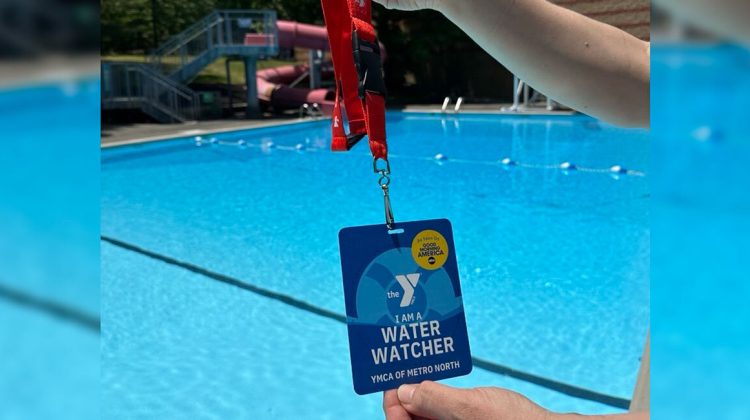
PEABODY — The Metro North YMCA is encouraging parents and caregivers to take a more active role in water safety through its Water Watcher badge program.
The Metro North YMCA’s pools in Lynn, Saugus, Peabody, and Melrose have been given more than 1,000 Water Watcher badges for all families, friends, and caretakers who spend time at the facilities, with hopes of them being taken home, said President of Metro North YMCA Kathleen Walsh.
The goal is for these badges to become contagious, Walsh said. “The best thing that could happen is adults all across the United States have these random tan marks from these Water Watcher lanyards,” Walsh said.
The Water Watcher badges have been around for a couple of years, but have been used very little so far, said Walsh. A recent segment on Good Morning America highlighted the safety risks associated with common pool toys and activities.
Green and red paddles were given to the show’s hosts by Lindsay Mondick, Y-USA’s director of aquatics and water safety, and were used to debunk myths about what is safe or unsafe for children’s overall safety in any body of water.
Jess Murray, the Metro North YMCA Director of Aquatics and Water Safety, shared that the segment provided a more accessible educational session for local families who may not know about factors that put their children at greater risk of drowning.
“It was such a good way to quickly give people some water safety tips that otherwise are either urban legends or parents just assume that they’re okay because folks don’t have that extra safety lens around the water that us aquatics professionals do have,” Murray said.
One thing Murray hopes to promote is the layers of safety bodies of water require. The first layer is parents or caregivers actively watching children, the second is lifeguards being present, and the third is swim testing children to ensure they’re strong enough swimmers in deeper water, Murray said.
“My real goal is that people take this awareness with them every day and that it doesn’t just stay within our doors,” Murray said. “Even if one family adopted this tradition and it helped them at one party this summer… It was worth it.”
Walsh brought awareness to some misconceptions that families and parents often make when at bigger aquatic spaces, like the beach. With a larger area to monitor, keeping an eye on children is more difficult for lifeguards, handing more of the responsibility to the adults.
As a young mother herself, she has had reality checks regarding aquatic safety for her children, Walsh said. Many parents go to the beach with the assumption of letting their kids play while they read a book or listen to a podcast, which can ultimately be one of the most dangerous things to do, Walsh said, because their eyes are not on the water or their kids.
“I used to try and sit near the lifeguards, because in my mind, the closer we are to the lifeguards, you know, the less work as a parent I have to do, and really, as I’ve obviously been in the thrill for a while, I have matured as a person,” Walsh said. “I recognize that the ultimate responsibility lives with the parents or the guardian or the adult that is charged with watching the child.”
Murray shared that a majority of the water rescues she makes happen outside of work, which has pushed her to educate and inform adults of the Water Watcher responsibility.
“I make more rescues on vacation or at friends’ houses in the summer than I ever would at our YMCAs, just because that’s the places that people don’t always think to have someone have an extra set of eyes on the pool,” Murray said.
Something often forgotten at home and at the beach is how dangerous the water can be for children when adults are not watching, Walsh said.
“We tend to forget when we get into social situations… that the pool, the body of water, is one of the most dangerous things our kids can be around,” Walsh said. “And the more that this can scale and grow, the safer the kids are gonna be.”
In the United States, drowning is the leading cause of death for children ages 1 to 4 and the second leading cause of death for children ages 5 to 14, according to the U.S. Centers for Disease Control and Prevention (CDC).
A recent Consumer Product Safety Commission (CPSC) report revealed that there was a 6% increase in fatal child drownings from 2022 to 2023, totaling 379 deaths. Close to 70% of the fatal drownings between 2021 and 2023 were in residential areas, according to the CPSC report.
Walsh believes that this is the summer when changes will be made to counteract the top cause of child deaths, which has been proven to be preventable.
“This is gonna catch on much more than it has in the past, and I do think other groups and organizations are going to want to partner with this because I think if we all hold hands and do this together, we all want to be a part of eradicating unnecessary drowning.”