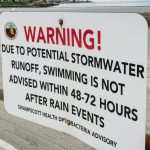
Residents are being advised to avoid swimming at King’s Beach and nearby coastal waters for at least 48 hours after Tuesday’s heavy rainfall, which triggered a combined sewer overflow into Nahant Bay.
The advisory was issued Wednesday by the Swampscott Health Department and the Lynn Water & Sewer Commission and notified residents that combined sewer overflow had discharged untreated or partially treated sewage into Nahant Bay and King’s Beach during Tuesday’s storm.
The message confirmed that the overflow had ceased at 5:55 p.m. on Tuesday, and warned residents to avoid contact with affected waters for 48 hours from that point because of increased health risks from bacteria and other pollutants.
The notification came less than 24 hours after the Swampscott Board of Health spent much of its Tuesday evening meeting discussing how rainfall affects beach water quality and announcing that weekday testing had kicked off at Fisherman’s Beach the day before.
The Fisherman’s testing supplements the town’s existing beach water testing program, which Public Health Director Jeff Vaughan conducts once a week at each of Swampscott’s six public beaches. The additional weekday testing is intended to provide a more detailed picture of water quality at a location that has drawn increased attention because of concerns about stormwater runoff.
Vaughan, who runs his beach water testing once a week on Wednesdays, said that an elevated bacteria result would prompt him to test again the following day before issuing a closure of a beach.
Officials also reemphasized that the water testing process takes roughly 24 hours and results are not immediately available to public health personnel. The board discussed its longstanding recommendation that residents stay out of the water for 48 to 72 hours after significant rainfall, when bacteria levels are most likely to increase.
The board briefly discussed whether it was within their purview to define what might constitute a “major rain event,” though they ultimately determined such a thing was not within their limits and could not be narrowly defined. Board of Health Chair Gargi Cooper noted that officials have seen unsafe bacteria levels after brief rains, and sometimes not after major storms, making the risk difficult to quantify.
“If it has rained, we are telling people: avoid the water. It’s kind of as simple as that,” Cooper said. “I know that’s not as sophisticated as people want to hear, but we don’t have the equipment.”
Allen also said that the college student intern administering the weekday testing at Fisherman’s will be collecting samples from both the Marshall Street and Cassidy Park culverts to help identify potential sources of bacterial contamination entering the harbor. The expanded monitoring follows infrastructure improvements completed over the past two years and should provide a much larger dataset to illustrate continued problems or (hopefully) progress.
“A lot of work has been done in terms of IDDE infrastructure work in that area over the last two years,” Allen said. “And I think it’s been a couple of years since any meaningful culvert testing was done. So I think that will be very useful.”
Allen did note that culvert testing would not happen every day, as the tester is sometimes taking samples in the morning during high tide. He said that sampling the culverts when the beach water levels are high could lead to misleading samples that are more ocean than culvert — something that he said might be problematic with current DCR culvert sampling data.
The board also discussed next steps in making beach water testing data publicly available to residents and beachgoers.
The Lynn and Swampscott combined sewer overflow notification included a link to a real-time online map showing the status of sewer overflows in the area.
Cooper said the town was working toward making the new Fisherman’s Beach monitoring results publicly available online as they are collected throughout the summer.
The results of Vaughan’s weekly testing are publicly available through the state’s Interactive Beach Water Quality Dashboard. Additional DCR testing data are available through SaveKingsBeach.com