PEABODY — When Addison Merrill graduated from Peabody Veterans Memorial High School last spring, she didn’t leave one of her biggest commitments behind.
Instead, she took it with her.
Now a student at Plymouth State University, Merrill is studying exercise science in an accelerated Doctor of Physical Therapy program. She is also balancing college life while continuing to organize heart screenings, educate families about sudden cardiac arrest, and advocate for greater access to preventative cardiac testing for young athletes.
The work began after the loss of her close friend, Freddy Espinal, who collapsed during wrestling practice in 2024 because of an undetected heart condition. Merrill said the tragedy left classmates searching for answers and motivated her to learn how similar deaths might be prevented.
“I remember that day going back to school,” Merrill said. “Everybody was just… there was a lot of confusion. It was just very sudden.”
As she learned more about sudden cardiac arrest in young athletes, she was surprised to discover that a routine sports physical often cannot detect many potentially life-threatening heart conditions.
“It’s just crazy how a five-minute screening can be the difference,” she said. “I could never imagine that happening to another person I know.”
Looking for answers, Merrill turned to her aunt, Beth Raucci, a New Hampshire school principal who hosts annual heart screening events. Raucci introduced her to Who We Play For, a nonprofit organization dedicated to preventing sudden cardiac death in young people through affordable electrocardiogram, or EKG, screenings.
Merrill contacted the organization’s New England Heart Screening director, registered nurse Emily Knight, to ask whether Peabody High School could host a screening.
That conversation led to Peabody High’s first Who We Play For heart screening during Merrill’s senior year. The event drew athletes and families from across the community and became one of several local efforts aimed at increasing awareness of sudden cardiac arrest following Freddy’s death.
“We got really good numbers,” Merrill said. “Everybody who was there just loved the cause because they all loved Freddy. He was just the kind of kid that everybody loved, so everybody wanted to do what they could.”
The success of that event encouraged Merrill to become more involved with the organization.
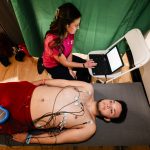
Today, she helps identify locations for future screenings, coordinates with schools and community organizations, performs EKGs after receiving specialized training, and assists with nearly every aspect of the events.
“I usually bring the ideas to Emily about where we can run them,” Merrill said. “For the YMCA screening, I got in touch with my boss, and then Emily explained the program. When it comes to the screenings, I’m kind of all over the place.”
She said her responsibilities range from performing EKGs to answering questions from families and helping participants through the screening process.
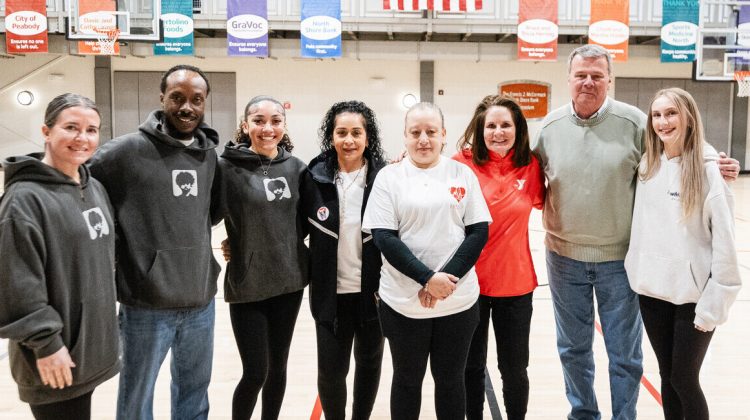
One of those ideas became this year’s screening at the Torigian Family YMCA, where Merrill also works as a lifeguard. She helped connect Who We Play For with YMCA leadership and returned home from college to volunteer throughout the event.
Beyond organizing screenings, Merrill has also focused on educating the public. During Sudden Cardiac Awareness Month, she created informational materials for the Espinal family to share throughout the community and has continued promoting the importance of preventative heart screenings.
She has also lent her voice to Freddy’s Law, legislation filed by state Rep. Tom Walsh that would require Massachusetts high school athletes to receive an EKG as part of their pre-participation sports physical. The proposal grew out of advocacy by the Espinal family following Freddy’s death and has since been joined by the family of Framingham State University student-athlete JJ Facey, who also died from an undiagnosed heart condition in 2024.
The bill has advanced through several legislative committees and is currently undergoing a state cost analysis that will help lawmakers determine the financial impact of requiring insurance coverage for the screenings before it can move forward.
Although Merrill was away at college during the State House hearing, she submitted a statement supporting the legislation and has continued helping advocates raise awareness.
“I’ve definitely helped Alexis with getting the word out,” she said, referring to Freddy’s sister, Alexis Espinal. “I’ve talked to Tom Walsh and kind of explained my piece of it.”
Merrill believes awareness has grown considerably since the first screening was held in Peabody.
“I think before the screening events, there was just a lot of confusion. Nobody really understood,” she said. “But after bringing it to light, everybody kind of understood it a little more.”
Her next goal is to bring the program to Plymouth State University.
She has already begun speaking with university officials and student leaders about organizing a screening for student-athletes.
“I definitely want to set one up there,” she said. “I know a lot of people on the sports teams, and I know they would definitely be out for that.”
Her advocacy has also influenced the direction of her career.
Although Merrill hopes to eventually open her own physical therapy practice, she has developed an interest in cardiac rehabilitation, helping patients recover after heart attacks and other heart conditions.
“That’s something I’m sure Freddy could have gotten into if he had seen his heart defect earlier,” she said. “People with heart conditions go through that, so I think that would be really cool.”
Even with the demands of college, internships, and work, Merrill plans to continue volunteering wherever she can.
Nearly two years after Freddy’s death, the effort that began in Peabody has expanded well beyond the city. Community heart screenings continue to be held across Massachusetts, lawmakers are considering Freddy’s Law, and Merrill is already working to bring the program to another college campus.
For her, every screening is another opportunity to make sure young athletes have access to a test that could identify a heart condition before it becomes a tragedy.
“Such a simple change, running a screening in your area, can change so many people’s lives,” Merrill said. “Even if you run one and it doesn’t flag anything, it’s just that relief that you can do the sports you love and never be worried.”