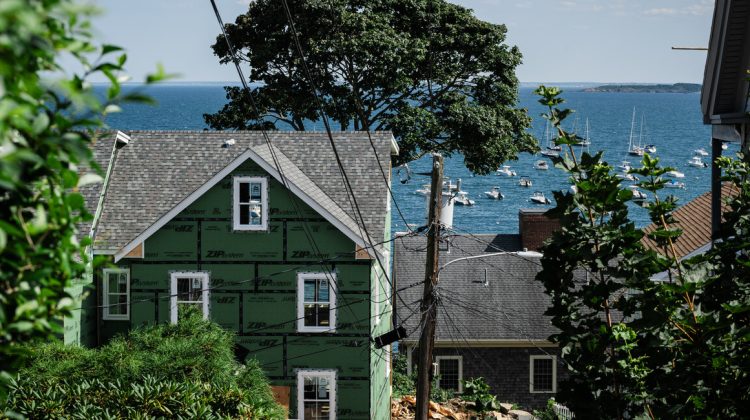
SWAMPSCOTT — The Zoning Board of Appeals unanimously rejected a resident’s challenge to a nearly completed addition at 24-28 Ingalls Terrace, concluding that its role was limited to determining whether the project was being built according to approved plans.
Tom Bogacz appeared before the board to speak on his appeal concerning Building Commissioner Richard Baldacci’s determination that the project complies with the town’s zoning bylaw, arguing the addition unnecessarily obstructs views of Swampscott Harbor from the public stairway known as the “40 Steps Path.”
The appeal centered on a provision of the town’s site plan review regulations requiring projects to “minimize obstruction of scenic views from publicly accessible locations.”
The project in question was approved by the Planning Board in January and will preserve and rehabilitate an existing single-family home while adding approximately 2,000 square feet to create a two-family townhouse-style residence.
Before Bogacz began his presentation, Zoning Board of Appeals Chair Heather Roman emphasized that the board’s review would need to be narrowly defined and that they were unable to revisit the decision on the plans that were approved in January.
“Our jurisdiction isn’t to go back to the original site plan review,” Roman said. “This is strictly whether the building somehow differs from what was approved by the Planning Board.”
During his presentation, Bogacz presented photographs, architectural drawings, zoning documents, and measurements that he said showed the project as constructed failed to satisfy the scenic-view requirement.
Bogacz argued that while the height measurements in the original plan may not have changed, that the building’s roof mass occupied a significantly larger portion of the harbor view than what was represented during the Planning Board process. He also questioned whether other aspects of the project, including setbacks, open-space calculations, and a third-floor configuration complied with the approved plans.
Bogacz said that during the Planning Board’s site plan review process, the structure was not shown from the perspective of the public path, and he wondered if the added context of the view obstruction warranted a change in the plans.
“I’m not asking the board to redesign the project,” Bogacz said. “I’m simply asking to evaluate this project against the actual scenic backdrop to determine if it actually does comply with the bylaw.”
In June, Baldacci determined the project was being built in substantial compliance with the approved plans, writing that any apparent differences resulted from field conditions, including the property’s topography. During the meeting, Baldacci and members of the ZBA noted that an as-built survey would be done to verify compliance with measurements once the project was complete.
Attorney Kenneth Schutzer attended the meeting and represented the property’s owner. Schutzer argued the board had only one legal question before it: whether the building deviated from the plans approved in January.
Schutzer noted that the Planning Board unanimously approved the project and that no appeal had been filed to that decision within the necessary time period, and that the building permit had similarly gone unchallenged.
“The record has to be set straight,” Schutzer said. “Unless you hear anything to the contrary from the building commissioner … this board doesn’t have the authority to do anything other than adopt the building commissioner’s determination.”
Schutzer also noted, though he said that he did not represent the owner at the time, that the Planning Board had considered the scenic obstruction bylaw during their review and that it was only one of several balancing priorities taken into consideration throughout the process.
Several residents spoke during public comment or submitted comments before the meeting. Those comments reflected a broader debate over how the town can balance increased housing production with preservation of Swampscott’s waterfront character.
Several residents spoke in support of Bogacz’s appeal, including Sharon Donovan, who said she appreciated the effort to rehabilitate the deteriorating historic house, but that she worried the town was losing one of its defining public vistas.
“When you get to the top of the steps, and it’s gone, it’s gone,” Donovan said. “What’s the point of having these parameters to guide us, to keep what makes Swampscott special?”
ZBA member Marc Kornitzky acknowledged Donovan’s concerns, saying he agreed that preserving Swampscott’s character is important. But he reaffirmed that the board’s authority in this case was limited.
“I agree with you on that 100%,” Kornitsky told Donovan. “We’re not in a position to second-guess the Planning Board. We’re only in a position to see if there’s been compliance with the approved plans.”
Kornitsky moved to deny the appeal, explaining that the board conducted an independent review of the evidence but found no proof that the project had deviated from what had previously been approved.
The board voted 5-0 to deny the appeal.
After the vote, Kornitsky informed Bogacz that once the written decision is filed with the town clerk, he will have the right to seek further review through the courts if he chooses to continue challenging the decision.