
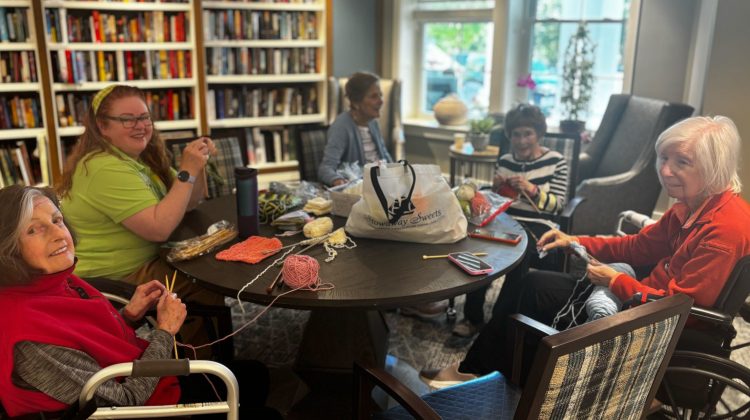
SWAMPSCOTT — On Tuesday mornings at The Residence at Vinnin Square, a table in the library room is covered in colorful yarn, knitting needles, and half-finished cotton washcloths.
Around it sit residents of varying knitting abilities. Some work confidently through rows of stitches. Others pause to ask for help, relearning skills they have not used in decades. Together, they are part of “Vinnin Knittin’,” a new resident-led club that is creating handmade washcloths and soaps for donation to local women’s shelters.
The project began with resident Joanne Casale, who wanted to bring knitters together around a common purpose.
“I get tired of knitting by myself,” Casale said. “I knew there were other people here who liked to knit … and I thought it would be nice if we could do something together.”
With support from staff, that idea quickly grew into a weekly gathering. Residents knit cotton cloths while another group creates handcrafted soaps using glycerin, fragrances, and dried flowers. The items will eventually be packaged together as gift baskets and donated to local women’s shelters.
For many participants, belonging to the knitting club has been about relearning an old skill and carrying a sense of nostalgia into their lives at the Residence.
“Most of us are kind of remembering from years ago,” resident Judy Eidelman said. “And once you sit down here you find out that you do remember it. It just comes back to you.”
Throughout the morning, conversations drifted between knitting techniques, family stories, and memories of the relatives who first taught them the craft. Many of the women around the table remembered learning to knit from their grandmothers.
“My grandmother taught me,” Casale said. “I don’t think she knew she was teaching me, but she was always knitting, and I was always just watching.”
Some residents are learning for the first time. Along with staff members like Maureen McKinnon, who is coming back to knitting herself, Casale would frequently give advice to fellow residents around the table, always encouraging others dealing with age-old knitting challenges: dropped stitches, slick needles, and more.
The group has also become an opportunity for residents facing physical challenges to stay engaged in a meaningful activity.
“Some of [the residents] do have trouble with our hands because of various diagnoses,” McKinnon said. “But everybody finds a way to participate.”
Conditions such as arthritis and Parkinson’s can make handling knitting needles more difficult. Rather than letting those limitations prevent participation, fellow knitters regularly offer advice, encouragement, and adaptations that help everyone contribute to the project.
The supportive atmosphere has become one of the club’s defining features. More experienced knitters teach beginners, while residents who are still learning or may have mobility challenges are encouraged to work at their own pace. Around the table, participants helped each other experiment with different sizes of needles. The group has experimented with different yarn thicknesses, and staff offered to find some crochet needles for participants who thought they might be easier to work with.
As the group worked, completed soaps were passed around the table for inspection. Residents admired the colorful creations, which feature embedded flowers and fragrances including lavender and jasmine.
As much as the group is about knitting, residents said it has also become an important social outlet. The weekly gatherings give participants a chance to catch up with neighbors, share stories, and spend time together.
Throughout the morning, conversations drifted from childhood memories and favorite hobbies to the other activities taking place around the community that day. Residents checked in with one another about upcoming programs, reminded friends about afternoon events, and made sure everyone was ready to head down to the dining room when lunchtime arrived.
The knitting itself, however, remains the main attraction.
“It can be very relaxing,” Eidelman said. “You can kind of not think about anything except the yarn in front of you and what you’re working on.”
Casale agreed, noting that the project offers a chance for residents to get together and not only accomplish a finished product, but enjoy each other’s company.
“It’s peaceful,” Casale said. “You just sit down, knit, talk with people, and enjoy being together.”